Of man & manners
O, Sean Charles Dunn, O, Sean Charles Dunn
How mad I was, sad when you hurled that bun!
Your freshly made sandwich just missed a cop’s gob,
And now I hear tell that you’re out of a job.
With apologies to Sir John Betjeman and “The Subaltern’s Love Song”
Here’s how it begins. I think. Not with Sean Charles, necessarily, but with a lot of people just like him from three generations of politically concerned youth in America.
Imagine that you are a young man from a loving home and good family, brought up to be well-mannered, always considerate of others, respectful to your elders and authority figures — someone who would no more think of screaming obscenities at strangers in the street than he would of shooting them. Your parents are proud of having raised a fine young man like you, but they also send you to college under the mistaken impression that college is a place to be educated, rather than radicalized.
I should have mentioned that, while you are at college, being radicalized, the worst thing that has ever happened in the world, er, happens. Or so your radical professors and your radical friends all seem to believe. It doesn’t really matter what it is — war in Vietnam or Iraq or Gaza; global warming, global cooling or climate change; the election of Richard Nixon or Ronald Reagan or Donald Trump or just some random instance of racism or sexism or Islamophobia — so long as everybody you know agrees that it is the worst thing that has ever happened in the world and that right-thinking people, like you, must do something about it. Especially you.
So then you get into a late-night dorm-room discussion with a few of your radical friends about what ought to be the something that you must do. Someone suggests that you scream: “F* you! You f*ing fascists!” at strangers in the street — strangers who may be seen as obliquely responsible for the worst thing that has ever happened in the world, if only because they won’t let you do something to stop it from happening.
Perhaps you still have the nerve to reply that that’s not how your loving parents taught you to behave in public, and couldn’t you do something more, well, more well-mannered instead? It is at this point, however, that someone hurls at you the killer argument with the force of a Subway sandwich. “What?” she says (I think of the someone as a she, since you are likely to find it particularly shaming for a female thus to question your manhood), “I can’t believe that you’re comparing [insert name of the worst thing that has ever happened in the world here] to a mere breach of decorum, a trifling lapse into bad manners!”
Clearly, there’s no comeback to this. You can only patiently await the next opportunity to scream “F* you! You f*ing fascists” at strangers in the street — preferably strangers who don’t want you to do something to stop the worst thing that has ever happened in the world from happening. If the stranger in the street is an authority figure and you happen to have a Subway sandwich in your hand, you might also think to hurl it at him. So much the better for you and your radical friends — and the worse for the stranger.
As I say, I don’t know that this is exactly how Sean Charles came to find himself on the wrong side of the law — and the sandwich. As a 37 year-old Air Force veteran he had probably not seen the inside of a college dormitory for some time — though not so long as you might suppose from his Linked-In profile, which lists his academic career at James Madison University as having begun in 1991, when he would have been four years old. But that kind of humiliation does tend to stay with you.
If that is not an accurate account of how Sean Charles came to believe that it was acceptable to protest against the worst thing that ever happened in the world with bad — let’s face it, actually pretty appalling — manners, it is an accurate account of how I came to believe the opposite. Several worst things that have ever happened in the world have come and gone since my college days during the famously “immoral” Vietnam War, but the breakdown in manners appears to have come to stay. That seems to me a sound reason for believing that bad manners are even worse than the worst thing that has ever happened in the world. In any case, they appear to be more irremediable.
And then there’s the quality of those other worst things in the world to consider. Once, I seem to remember, it was one’s president sending troops to Vietnam — not to mention his potentially sending one to Vietnam — to fight a ruthless Communist enemy bent, as many supposed at the time, on taking over the world and turning it into a vast prison camp for well-mannered sons and daughters of the bourgeoisie. Pretty bad, I think you will agree.
But what got Sean Charles’s dander up was the president’s sending troops to the Federal District of Columbia — his own back yard, as it were — to help the police suppress crime there. Either Sean had decided that he was pro-crime, which I doubt, or that he would forget everything he ever knew about good manners, consideration for others and respect for duly constituted authority (of which, as a Department of Justice employee, he was himself a representative) over a mere jurisdictional dispute sure to be resolved by the courts without any need for gratuitous sandwich-chucking on his part.
What kind of worst-thing-that-has-ever-happened-in-the-world is that? You might almost think that Sean Charles, like so many Democrats these days, was simply “acting out” (as they say of young children who have yet to learn their manners) or going through the revolutionary motions to impress that long-remembered chick back in the dorm room for want of anything better to do. Or maybe the chick in the dorm was Christina Cauterucci of Slate whose article about the incident was headlined, “A Hero Threw a Hero: Sometimes the only way to fight fascism is with a $5 footlong.”
We should all be grateful, I suppose, that ours is one of those times, when a man can be a hero simply by throwing a sandwich at a cop and so avoiding all the more sanguinary ways of fighting fascism — which were once a big part of the reason why people thought fascism needed to be fought with in the first place. If the fascist threat can now only be confronted with flying cold cuts, the very least you can say about it is that it can’t be anything like the threat it used to be.
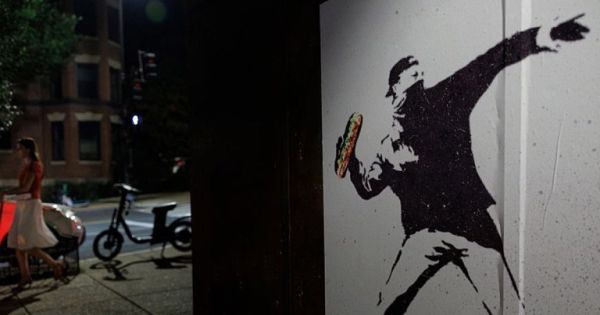
But then we knew that already, didn’t we? “Fascism,” as I have had occasion to mention before (see, for example, “Faux fascisti” in The New Criterion of December, 2024) has now been defined down to mean, at convenience, any locally unwelcome effort to enforce laws of long standing, written by democratically elected governments. That the new federal presence in the federal city is unwelcome, we have the word of The New York Times, which praised Sean Charles indirectly — without mentioning his name — by making out that he has already become a legendary hero to the simple folk of Washington, D.C., perhaps like Paul Bunyan or Johnny Appleseed. “A former Justice Department employee who threw a sandwich at a federal agent,” wrote Clyde McGrady, Bernard Mokam and Pooja Salhotra for the Times, “has become a folk hero, his image lighting up the cityscape.”
Dimly aware, perhaps, of the absurdity of any such concept of heroism, Clyde and Bernard and Pooja attempted to justify people who think of some extra crime-fighters for D.C. as something not entirely unadjacent to the worst thing that has ever happened in the world by citing the alleged unanimity (or something not entirely unadjacent to unanimity) of the local population against the beefed up federal presence:
To those who have never lived in the 68 square miles of Washington, the nation’s capital can seem to lack an authentic residential and cultural identity. Transient populations come and go with alternating administrations. . .But the recent deployment of hundreds of often masked federal agents and hundreds more National Guard troops have brought many Washingtonians a sense of shared purpose: outrage. “We are not against fighting crime,” said Tony Guardad, a 49- year-old construction worker, who emphasized that he is not against the police. “But we are against boots on the street, and we don’t want to feel like we are in North Korea.”
Yet neither Clyde, nor Bernard, nor Pooja thought to ask Tony if he felt like he was in North Korea when Joe Biden brought 20,000 National Guardsmen to Washington to make sure that his inauguration and first months in office were all smooth sailing and untroubled by protestors like himself.
But the mask slips a little further down in the piece when, in response to a remark by White House deputy chief of staff Stephen Miller that the protestors “were ‘elderly white hippies’ standing in the way of law enforcement officers protecting a majority Black city,” the Times authors pointed out that owing to gentrification (not to mention expansion of the federal government) in recent years, whites were almost as numerous as blacks in the capital today — as if that were a reason for unconcern about crime in the remaining black neighborhoods of the city.
This leads on to the following interesting observation:
And because of its unique concentration of political think tanks, union headquarters, nonprofit organizations, lobbying outfits and international development banks, Washington is full of people with plenty of experience organizing and generating outrage. To be sure, many Washingtonians have been going about their business without taking to the streets. Nadine Seiler, a 60-year-old activist from Waldorf, Md., lamented the “perpetually low turnout” at protests, reflecting the desire of protest organizers to always want more participants. “Whether it’s fear or something else, people are just not coming out in the numbers we need them to,” she said.
So much for the portrait of a city united in outrage against the alleged fascist in the White House — or in admiration for its sandwich-lobbing folk hero. For the media themselves are and of course long have been among the many Washingtonians “with plenty of experience organizing and generating outrage” — mainly by persuading generation after generation of callow and historically ignorant youths that the latest scandal to roll off the media assembly line is the worst thing that has ever happened in the world and requires their instant attention.
Meanwhile, some pretty awful things continue to happen with alarming regularity, even if they don’t measure up to the media’s exacting standards for bringing “outrage” into the streets. Towards the end of August, a 23-year-old “transgender” youth — whom, in keeping with my usual practice, I forbear to name — murdered two young children and wounded many others during mass at the Annunciation Catholic School in Minneapolis before killing himself.
By now the media’s response to events like these has almost become Pavlovian: blame the guns rather than the man who used them. But this time, though guns were mentioned, there was more concern to warn off anyone who might be tempted to blame the shooter’s “gender” confusion. “The right-wing uproar over Ms. X’s gender identity,” wrote Talya Minsberg, Amy Harmon and Aric Toler for The New York Times,
echoed the politicized reaction to a 2023 mass shooting at The Covenant School in Nashville, which was carried out by a former student whom the police said was transgender. In a news conference, Mayor Jacob Frey of Minneapolis, a Democrat, urged the public to avoid scapegoating transgender people in the wake of the tragedy. I’ve heard a whole lot of hate directed at our trans community,” he said. “Anybody that is using this as an opportunity to villainize our trans community — or any other community out there — has lost their sense of common humanity.”
Judging by the list of grievances and hatreds found among the shooter’s literary remains — a list obviously intended to be found and published to memorialize the event — it was she/he who had lost his sense of common humanity. There was hatred for what we used to think of as “normality” in every line, yet it was those who noticed this, and made some kind of connection to the killer’s most salient form of abnormality before the killings who were censured for “hatred.” “We should not be operating out of a place of hate for anyone,” continued Mayor Frey, “we should be operating out of a place of love for our kids. . . Kids died today. This needs to be about them.”
This sounded oddly like a plea for good manners and forbearance in those who might otherwise be disposed to outrage against anyone whom they saw as an apologist for a murderer of children. It reminded me of those Britons, of whom there are still a great many in the media and the government, whose own outrage is directed not at the immigrant gangs of child rapists in several northern cities but at those who are outraged by such gangs and by the tolerance shown to them by the country’s excessively well-mannered “hate” monitors, who seem to have taken the place of its police force.
There, too, our “common humanity” has taken a back seat to the consideration due, according to the long-dominant canons of identity politics, to those who would deny it. The notionally oppressed, including “our trans community,” are excused the mannerly behavior expected of their notional oppressors. Can anyone wonder if such indulgence extended to the outrage of the proudly abnormal against the normal — or what used to be as normal as children at prayer — sometimes leads to results like the Minneapolis child murders?
More often, of course, it only leads to Sean the sandwich-slinger (say that three times quickly) and his historically confused notions about what “fascism” is. Him we can laugh at, with the laughter that comes, as so much of laughter does come, from an incongruity between his view of himself in something like the heroic mold fitted for him by Christina Cauterucci and the view of him as a self-deluded buffoon taken by normal people.
I can’t help wondering, however, why realities that appear so exigent in the late-night dorm rooms of the world, whether figurative or actual, continue to appear so to some people even after their exposure to the light of day reveals them, and those who cling to them, to be so ridiculous? Are the readers of Slate and the rest of the left-wing media, in other words, genuine believers in Sean’s heroism and the fascist menace he purports to oppose, or are they only pretending to believe, out of the left-wing equivalent of good manners and respect for the party line?
We may never know. But what anyone may know is that the Federal police and National Guard presence in the District of Columbia is only one of several indications of President Trump’s political genius in always managing to put the Democrats, as Reince Priebus said on the ABC “This Week” round table, “on the wrong side of normal.” Admittedly, they make it easy for him, but even they must see, sooner or later, that if they want to win elections the wrong side of normal is not a place they want to be.
Discover more from James Bowman
Subscribe to get the latest posts to your email.