The Devil Wears Prada 2
 Don't Bother
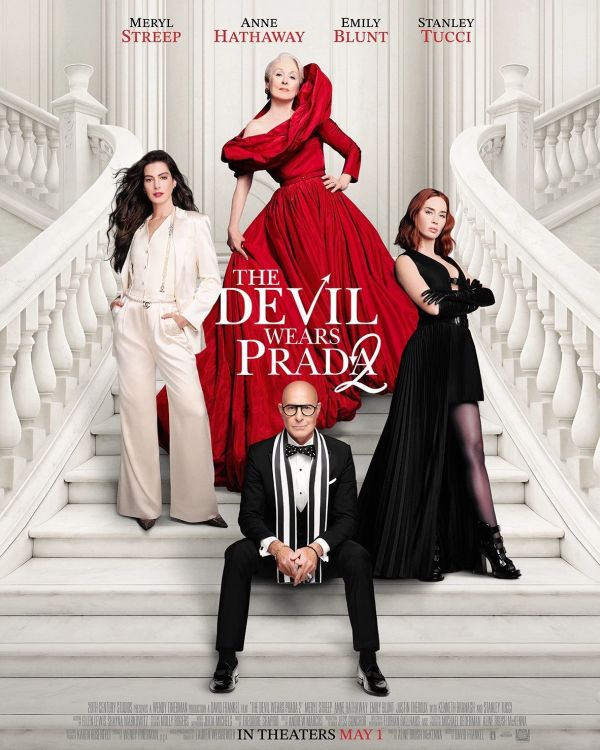
The sub-head of the New York Times review of The Devil Wears Prada 2 reads as follows: “In this sequel, Andy (Anne Hathaway) and Miranda (Meryl Streep) encounter a series of crises that set the stage for a larger existential catastrophe.” Having seen the movie, I’m not sure what the allegedly “existential catastrophe” (the words are those of the review’s author, Manohla Dargis, and not an editor) is meant to be, but I suspect it has to do with what some of us regard as the very non-catastrophic collapse of the business model of the media which is sometimes called “legacy.”
In other words, what looks like an existential catastrophe to legacy media like the New York Times looks a lot like hope and change (© Barak Obama) to those who look at the world as those media do not. At the beginning of the picture, Miss Hathaway’s heroine, Andy Sachs, wins an award for investigative journalism and loses her job as an investigative journalist at almost the same moment. In fact, she learns her fate at the awards banquet and, in her acceptance speech, opines to thunderous applause that “some things matter more than money. Journalism still f***ing matters!”
Fortunately for her, Runway magazine, her employer at the time of the first Devil Wears Prada film 20 years ago, is in the midst of a scandal involving sweatshop labor at one of its recommended fashion houses which is causing advertisers to pull their ads. The magazine’s publisher, Irv (Tibor Feldman) quickly realizes that the way for it to start making money again is to hire the woman who has just shot to fame for saying that “some things matter more than money.”
I’m not sure that the film is quite aware of this irony. I’m pretty sure that its heroine is not.
Anyway, this is how Andy returns to being bossed around, like everybody else at the magazine, by the imperious Miranda Priestly (Miss Streep) who, as might have been expected, has no use for the deputy editor wished upon her by the publisher and doesn’t even remember Andy from her first time around at the magazine. But her indifference to her underlings, except as a stick with which to beat other underlings, reappears when she fires the existing deputy over the phone and then tells Andy, “You just cost Cornell summa cum laude her job. The first in her family to go to college.”
And yet — wouldn’t you know it — the two women are brought together in an effort to save the magazine for “journalism” when the publisher, Irv’s son and successor, Jay (B.J. Novak), calls in a management consultancy with a view to downsizing and automating it virtually out of existence. “I can’t just accept that,” says Andy. “We can’t just keep sucking the soul of everything and gutting it and then repackaging it. To what end?”
Up until now we are meant to doubt that Miranda even has a soul, but so it proves. Not only does she team up with her formerly despised underling to find a billionaire who who will buy the magazine and let Miranda run it as Miranda has always run it, but she is also given the line to go with the movie’s money-shot (you should excuse the expression) of Leonardo’s Last Supper when she says that Runway stands for “a commitment to beauty, artistry, the very best in human innovation.”
Generally, I subscribe to the proposition that, as my friend Steven Hayward says, you can’t hate the media enough — and especially those of its high priests and pharisees who bleat about the noble journalistic “profession.” Apart from the sweatshop puffery, the only substantive journalism in Runway that we are made aware of is a gossipy interview with the discarded wife (Lucy Liu) of a billionaire who is now, like Jeff Bezos’s ex, MacKenzie Scott, a billionaire herself. She then goes on [spoiler alert!] to be the billionaire who saves the magazine for Miranda.
Yet it may be a hopeful sign for the culture that The Devil Wears Prada 2 shunts its journalistic paragon into writing about fashion and gossip and keeps her, and us, out of the political advocacy that has been the ruin of real-world journalism. There is even one moment when the movie hints that Andy might be capable of a smidgen of self-awareness. Her love interest this time around is an Australian builder named Peter who has renovated the luxury apartment building she moves into after supplanting Cornell summa cum laude at Runway. When Andy gets on her high horse about journalism’s (and of course journalists’) being more important than people who merely renovate luxury apartments for a living, it almost kills the romance.
Has she glimpsed, for only a moment, her own arrogant self-importance? We are not told but are left to infer some degree of shame or penitence from her flinging herself into Peter’s welcoming arms on her return from saving the magazine. Love, for her, means never having to say she’s sorry, and Peter apparently doesn’t expect any expression of regret, let alone humility from her. Being a self-glorifying gossip-monger is, as you might imagine in Hollywood, presumably the most forgivable of sins.
For this is a chick-flick, after all, and one that does not involve the chicks’ in question behaving like gay men (as a long-ago Simpsons joke characterized Sex in the City). As such, it can be enjoyed by anyone who likes to see the ladies made happy as they only can be by our heroine’s turning not one but two evil bitches (the other is Emily Blunt, reprising her role as Emily in the earlier film, who is now supposed to be running Dior) into pussycats with her ingenuous charm. And although fashion magazines, let alone “journalism,” in these United States may actually have very little to do with beauty, artistry, and the very best in human innovation, these things are indeed worth celebrating, even if it’s only for show.
Discover more from James Bowman
Subscribe to get the latest posts sent to your email.