Honor killing
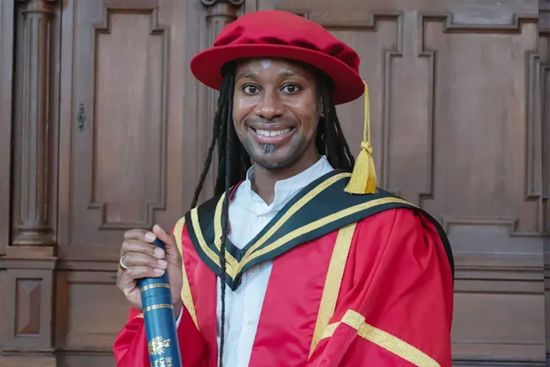
“Nothing in his life/Became him like the leaving it.” Those are the words of Prince Malcolm of Scotland, in Act One of Macbeth, to his father, King Duncan, on the execution of the treacherous Thane of Cawdor. I think they might also apply to the late Professor Jason Arday, Ph.D., of Jesus College and Cambridge University.
To explain his admiration for the decorum with which Cawdor met his death, Malcolm says that the ex-thane (Macbeth now wears his “borrowed robes”) “very frankly. . . confessed his treason,/ Implored your highness’ pardon, and set forth/A deep repentance.”
That, of course, cannot be said of Mr Arday. But then, unlike Cawdor, he was not offered the unique forum of a public execution in which to make such a confession or profess his deep repentance for the lies by which he had ascended to his brief eminence. Instead he took the Roman way of a private suicide — which, it could be argued, itself amounts to a form of confession and repentance, as well as being, by ancient tradition, an honorable death.
In this, at least, the late professor’s regrettable self-slaughter ought to be considered the exact opposite of the racially motivated “lynching” that Ibram X. Kendi and some others of his many public sympathizers compared it to. Lynching not only kills but also humiliates its victim; suicide as a response to humiliation does the opposite: it wipes away humiliation by reclaiming the victim’s manhood and agency in the only way he sees left to him.
Mr Arday thus renounced those rights of victimhood — including the right not to feel humiliated no matter what he had done — whose assertion was the sole reason for his champions in the media and elsewhere to have taken up his cause in the first place.
The humiliation to Cambridge University — my university — is not so easily erased. As the blogger Ed West noted,
Before Arday’s death, there was growing unrest at Cambridge and demands that the university explain why it had appointed someone so clearly unsuitable. Following that tragedy, the focus all changed: numerous internal emails went around offering mental health support, particularly to ‘students and faculty of colour’. Cambridge, which has suffered a huge reputational hit following the affair, will be excused the necessity of having to rebuild it. The university has since stated that it is ‘reaching out’ to students, expressing how appalled it was that ‘Black students’ are receiving abuse. There is no sign that the institution is seeking repentance, and indeed the language of therapy, often barely distinguishable from the language of public relations, is its antithesis.
Here, for example, is University Vice-Chancellor Deborah Prentice in her official statement, issued after Arday’s apparent suicide:
I hope that this painful and difficult time can also be one of compassion. I ask you to be mindful of your own health and wellbeing, and in the coming days, weeks and months, please know that there is a range of support available to you. . . . I want to be clear: supporting our community through this tragedy is the single most important priority for me and my leadership team right now. We will be reaching out to many of you directly, and we are committed to ensuring that no one feels they must face this alone. [emphasis added]
She needn’t have worried. I think we can be reasonably certain that no one tangentially related, at best, to the affair does feel, as Mr Arday himself apparently did, that he must face this tragedy alone — or, indeed, must face its moral and political implications at all. “Compassion”— for each other, if not for Jason — means that no one need care anymore about the shameful attempt by the university to win an undeserved honor for itself by appointing a grossly unqualified person as the youngest black professor in its 800-year history.
Otherwise, the compassionated ones might have to call into question all the university’s other appointments — including those of the people now calling on colleagues, in a time of tragedy, to think of their own “health and wellbeing” as their “single most important priority.”
Moreover, the invocation of “compassion” implicitly takes the side of those who blamed the media (especially, amusingly enough, The Guardian, which in spite of its impeccably progressive credentials had led the media pack in exposing Arday’s fraud) and anyone else who helped reveal the truth. Such misdirected attribution of responsibility for his death would deny the poor man the honor he must have sought in claiming it for himself and refusing to be a victim.
But just as a tree that falls in the forest makes no sound if there is nobody around to hear it, so can there be no humiliation in an otherwise humiliating event if there’s no one around capable of feeling humiliated, as Jason Arday himself apparently, if quite anachronistically, was. The great mystery of his death, to me, is where and how a young man, otherwise so much a creature of his time and place, can have acquired such an old-fashioned sense of honor?
Never let it be said, however, that I would have recommended such an act to him, any more than I would the fraud that occasioned it. It’s true that I am an admirer of the now-defunct Western honor culture, ultimately derived from the Roman one that prescribed suicide as the appropriate response to public shame. But I’m not so mad as to have supposed that the deed would have been understood in such terms today by anybody but me — and, now, poor Jason. An honorable act ceases to be an honorable act when there’s no honor group extant which is prepared to call it one, and no one else alive, to judge from the media response, still capable of recognizing it as such.
Yet I hope that I may be allowed to think more highly of the man, and of his manhood, for acknowledging his fault in the most sincere manner imaginable, especially when there was no need for him to have done so. Indeed, as Abe Greenwald pointed out, he could have claimed that his fraudulent résumé was a sociological experiment, which it really kind of was. “That Arday conned his way into Cambridge,” he wrote for Commentary, “means he knew more about sociology than anyone else in his department.”
He could then have gone on, Mr Greenwald continued, to be a pop cultural celebrity, like his fellow fabulists George Santos or Frank Abagnale. Yet instead of cashing in on the opportunities afforded his kind by our post-honor culture, he reverted to the standard of a now almost unimaginably distant past when fame (“that last infirmity of noble mind,” according to Milton) and honor were supposed to be inseparable, and the shame of dishonor thought to be, as a 17th century melodrama once put it in a phrase that has been mercilessly parodied ever since, “a fate worse than death.”
Too bad nobody ever told Jason Arday that all he had to do to atone to the jackals of the media for his sins against the public trust was to say, with a merry laugh, that he had been “a little crazy,” back in the day. Democratic Congressperson Alexandria Ocasio-Cortez didn’t even have to do that much when, in conversation with Jonathan Karl of ABC News, she said, to the delight of almost everyone, including herself, that “Woke One was crazy.”
Nota Bene. Not: “I was crazy” — or even just slightly deluded — let alone wrong. The words themselves were not her own but those of a New York City Council member, said to be Chi Ossé of Bedford–Stuyvesant in Brooklyn. Both he and “AOC,” as she is affectionately known to the media, themselves could thus be said to have been only ambiguously and tentatively connected to “Woke One” to begin with. And now they were choosing to be seen as so much more satisfactorily connected to a presumptive Woke Two, whatever that may turn out to be. Certainly not crazy, anyway.
As Carlos Lozada wrote for The New York Times:
I have one question for the formerly woke: If you can dismiss it so casually now — all the defunding and abolishing, the BIPOCing and Latinxing, the canceling and decentering and my truthing — how much of it did you truly believe at the time? How much was conviction, how much was a pose, how much was groupthink, how much was fear? If you did believe it, jettisoning it now should take something more than a sheepish grin. If you didn’t believe it and yet declared it with such passion, with such pretensions to moral clarity, with such disdain for contrary perspectives, then the least you can do now is acknowledge that dissonance. . . In her interview, Ocasio-Cortez attributes the excesses of the woke era in part to the pressures of pandemic restrictions, saying that “of course, rhetoric in that time is not rhetoric that we would use today.” But that’s just a canny restatement of her shift, not an explanation for it. Would Ocasio-Cortez not use the same rhetoric today because she no longer buys it — or because she can no longer sell it?
I think we all know the answer to that question. I could hardly have supposed, when I wrote my last media column of the last volume year (see “Never mind” in The New Criterion of June, 2026), differentiating between those who could sincerely admit to fault or error and those who only pretended to do so to gain political advantage, that I would so soon be vouchsafed such perfect examples of the two types as Jason Arday and Ms Ocasio-Cortez.
Not that examples of the pretenders, at least, were at all hard to find. AOC, for example, was just one of those who emerged from what Andy Kessler of the Wall Street Journal called at the time “the summer of ‘my bad.’” That expression, by the way, which I first remember hearing 20 years ago, seems to me an infallible indicator of AOC-like insincerity as well as another form of infantilization, like Vice-Chancellor Prentice’s, in a land that has so definitively left its honor culture behind it. People who say “my bad,” invariably do so ironically — to tell you that they are willing to apologize for mistakes or offenses only by adopting a babyish language, in order to imply that the fault, too, was babyish and thus rather cute than serious. It is not under any circumstances to be held against the offender, pending further apology.
Ms Ocasio-Cortez herself had not even acknowledged as her own the “bad” she professed (sort of) to regret, and she had little more to say on the matter, beyond her invocation of the Overton Window, said to have been open a crack more widely, in the days of Covid-19 and George Floyd, than it is in our own time. But her many apologists in the media were quick to interpret her non-apology apology for her. Astead Herndon of Vox, for example, wrote that
the broad ideals — diversity, equity, a basic sense of fairness — still matter to Democratic voters. Criminal justice reform still has real purchase with the base. Minority and women candidates have kept winning since 2024, and even ideas like reparations still resonate with big chunks of the Democratic electorate. What’s changed isn’t who these candidates are — it’s what they choose to lead with. What has fallen out of favor is a way of talking. Let’s say it’s the nonprofit register, or the Ford Foundation cadence — the language that lived in mission statements and land acknowledgments, or that made sweeping generalizations about a specific group — white women, cis men, you name it. David Axelrod, describing Wisconsin’s Francesca Hong, gave it this label: a “font of zany liberal, faculty lounge exotica.” Yes, that’s the part that’s gotten less popular. The vocabulary changed more than the values.
Note the implicit acknowledgment that the change is in response to a shift in public opinion, not a real change of mind on the part of the radicals: “What has fallen out of favor is a way of talking” — which can only mean that there’s been no real change in the same way of thinking. As Ms Ocasio-Cortez herself put it, “rhetoric in that time is not rhetoric that we would use today.”
So much, then, for the idea, expressed by, among others, Zeeshan Aleem for MS-NOW that Ms Ocasio-Cortez was adumbrating a serious thesis on “how the left is evolving.” On the contrary, as the mid-term elections approached it became increasingly evident that “the left,” now indistinguishable from the Democratic party, was devolving — to its default position since January, 2017 of root-and-branch hostility to Donald Trump and all his works. No more were there any soul-searchings or banal “post-mortem” musings about the “falling out of favor” with voters of the party itself. One thinks, not for the first time, of the most popular definition of what it means to be “a little crazy,” which is doing the same thing over and over again and hoping for a different result.
The brief aberration or detour from Crazy Street, insofar as there had ever been one, had come in the period after November, 2024 when the Democrats were said to have been doing some hard thinking about where they had gone wrong in recommending themselves to voters in that month’s election. If there ever were any such thinking, the approach of this year’s mid-term elections put an abrupt end to it — an end signaled, perhaps, by House Minority leader Hakim Jeffries’s announcement that, in the event that the Democrats are returned to the Congressional majority, “We’re Going To Hold Every Single Member Of The Trump Cartel [sic] Accountable.”
Mr Jeffries had come under pressure after it was reported that he had met with the president’s son-in-law, Jared Kushner. The ever-reliable James Carville reacted as we have come to expect from him:
“On one thing, on one thing, there is no disagreement [i.e. among Democrats],” he said. “There’s unanimity. And it is simply this: in the opinion of every Democrat in the United States, progressive, moderate, middle road, left, f*ck, I don’t know whatever you want, we believe one thing above all. These people [i.e. the Trump family and/or his administration] are a pack of felons and traitors and you do not meet with them. You do not meet with them!”
Sometimes the Democrats like to remind us that they are the people who invented the ironically named “hate crime” as the sin against the Woke spirit. For whatever else there is about that spirit that might be retrospectively regrettable to them, the centrality of a burning hatred for those whom it sees as its enemies is not. Or maybe they just can’t help themselves. In any case, they would not be saying things of the kind that Messrs Jeffries and Carville are saying if they did not feel pretty confident that they will be holding the congressional whip hand come January, 2027.
Perhaps they will. But if they do, it will not be because anyone believes that they have learned anything, changed their minds about anything, since 2024 — or, indeed, since 2020 or 2016. They are what they have been for over a decade now, and if they weren’t so busy casting about to find out whom to hate in the Jason Arday affair, they might learn from him something of the honor potentially accruing, had we the wit in today’s post-honor culture to see it, to those who can admit to being wrong.
Discover more from James Bowman
Subscribe to get the latest posts sent to your email.