As we forgive those. . .
Rod Dreher, the author and Stakhanovite substacker whose writings are always worth reading, is shocked by President Trump’s admission that he cannot forgive his enemies. In Mr Trump’s interview on “60 Minutes” with Ross Douthat, the following exchange took place:
“Mr. President,” said Mr Douthat, “you have had the most charmed and remarkable life of any person in my lifetime, and you are telling me that before the judgment throne of God, you could not find it in your heart to forgive some of your enemies? After all that’s been given to you?”
Mr Trump, perhaps better aware than his questioner of “all that’s been given” to him, answered: “Ross, can I be honest? I probably cannot do that, no. Because I do hate some of my enemies, and I always will.”
I immediately thought of Nancy Pelosi, mentioned by Mr Douthat as one of those Mr Trump ought to be able to forgive, and her reply, back in 2019, to a questioner asking if she hated then-President Donald Trump. It was obvious that, among the Democratic party’s many, many Trump-haters, she took a back seat to no one. But she replied: “I donʼt hate anybody. I was raised in a Catholic house, we donʼt hate anybody—not anybody in the world,”
I’m going to go out on a limb here and say not only that nobody believed this but that she never expected anybody to believe it. If she didn’t hate the reporter who asked the question she gave a pretty good imitation of doing so. She just gave the answer — or an answer — that the media expected her to give: an answer consistent with their “narrative” about Democratic decency and Republican wickedness. I’ll go further and suggest that it never occurred to Ms Pelosi for a moment to wonder if, as a Catholic, she might pay an eternal price, either for her hatred or for her blatant lie about it.
Donald Trump was not to be let off so easily, either by the media or by God. On his Substack,
Rod Dreher commented:
There you have it. If Donald Trump dies in his sleep tonight, barring the extraordinary mercy of God — and I am very glad God makes these calls, not me or you — he will go to Hell. Scripture could not be clearer.
I am always ready to listen to anything Mr Dreher has to say about his own religious faith, but here, I think, he is mistaking one of the tenets of the therapeutic culture for established Christian doctrine.
That the president may well pay a psychological price for treasuring up his grievances I have no doubt, but the price of his very soul? I’m not so sure. What if his enemies don’t want to be forgiven? What, moreover, if they don’t believe they have anything to be forgiven for? What if, like Nancy Pelosi, they are equally (or even more) unforgiving to him? I’m not sure that it can be, as Messrs Douthat and Dreher both seem to suggest it is, obligatory for a Christian to believe that a man who withholds his own forgiveness from such unforgiving enemies is perforce destined to eternal damnation.
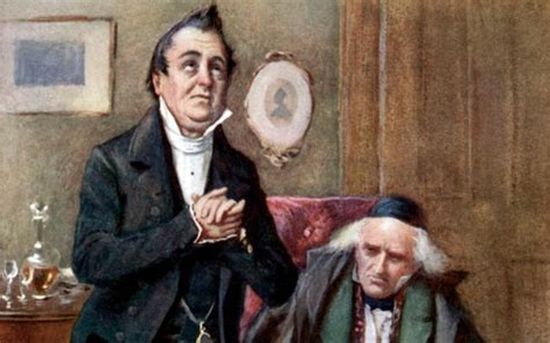
Consider the following passage from Charles Dickens’s novel, Martin Chuzzlewit (1844). describing a scene between Seth Pecksniff, a soi-disant architect and Pelosi-grade hypocrite, and his former apprentice, John Westlock:
‘No, John,’said Mr. Pecksniff, with a calmness quite ethereal; ‘no, I will not shake hands, John. I have forgiven you. I had already forgiven you, even before you ceased to reproach and taunt me. I have embraced you in the spirit, John, which is better than shaking hands.’ . . .
‘As to your forgiveness, Mr. Pecksniff,’ said the youth, ‘I’ll not have it upon such terms. I won’t be forgiven.’
‘Won’t you, John?’ retorted Mr. Pecksniff, with a smile. ‘You must. You can’t help it. Forgiveness is a high quality; an exalted virtue; far above your control or influence, John. I will forgive you. You cannot move me to remember any wrong you have ever done me, John.’;
‘Wrong!’ cried the other, with all the heat and impetuosity of his age. ‘Here’s a pretty fellow! Wrong! Wrong I have done him! He’ll not even remember the five hundred pounds he had with me under false pretences; or the seventy pounds a year for board and lodging that would have been dear at seventeen! Here’s a martyr!’
‘Money, John,’ said Mr. Pecksniff, ‘is the root of all evil. I grieve to see that it is already bearing evil fruit in you. But I will not remember its existence.’
Isn’t it a species of arrogance and self-righteousness, like Pecksniff’s, to proclaim your forgiveness of those who still exult, as you see it, in the wrongs they have done you by mentioning the wrongs you have done them?
I would not be thought to share the attitude of the anonymous author of the Old English poem Christ III who believed that one of the joys of the blessed in heaven will be to watch with pleasure the sufferings of the damned, but neither do I share what the psychologist Gad Saad calls the “suicidal empathy” of, say, the Jews in Michigan who voted for a jihadi-adjacent senator, or the woman who refused to press charges against a man who violently assaulted her (thus setting him free to commit a subsequent murder) on the grounds that he, too, was a victim. To her credit, the woman regretted her decision when told of her assailant’s subsequent criminal act.
“To err is human, to forgive, divine,” wrote Alexander Pope, and to forgive those who seek our forgiveness is surely to participate, so far as is humanly possible, in the divine. But the formula from the Lord’s Prayer — “forgive us our trespasses, as we forgive those who trespass against us” — can be read in two ways. Forgive, unconditionally, here on earth, that you may be forgiven, unconditionally, OR forgive, as God forgives, those who ask for forgiveness. For, presumably, the existence of the hell that Rod Dreher thinks President Trump is bound for shows that God Himself does not forgive those who do not seek His forgiveness.
Discover more from James Bowman
Subscribe to get the latest posts sent to your email.