Joking matters
One of my all-time favorite funny headlines appeared at the end of the first week of the media frenzy following the murder of Charlie Kirk. I’ll get to the funny headline in a moment, but first a brief aside about that murder from Mark Steyn:
My memory of young fatherhood — when the children are three and under, and their love for you exists at a level far beyond consciousness and rationalisation — is sufficiently vivid that I can’t really find much consolation in the public outpourings over Charlie Kirk. None of the “good” that is said to have come from his martyrdom — the new Turning Point chapters, etc — outweighs the absence to one little girl and boy of their father, and his reduction in their childhood to an image in a photo album and a voice on tape. But the weeks roll by, and terror is democratised: you go to a restaurant, you go to school, you go to church, you go to sports practice …and you get shot. One half of the country thinks it has a public-policy disagreement; the other half thinks you’re evil — and, from that, certain consequences follow.
Nothing funny about that is there? This is why I prefer the word “murder” to “assassination” to describe what happened at Utah Valley University on September 10. The latter word dignifies the act by imputing to it a rational motive. Charlie Kirk’s killer was no more rational than the murderers of Irina Zarutska on a commuter train in Charlotte, North Carolina, or of two school-children in Minneapolis a couple of weeks earlier. All three murderers owed their mental derangement at least in part to an irrational hatred for victims of whom they knew nothing except that, in their own disordered minds, they deserved to die.
I had not thought to return to the subject of manners so soon (see “Of manners and man” in The New Criterion of October, 2025), but the murders mentioned above brought a new resonance to the subject, as I see it. For although it sounds strange to say so, the killers in all three of these cases were pretty obviously possessed by a moral frenzy similar to, though obviously much more extreme than, that of Sean Dunn, whose bad manners in throwing food at random federal officers I discussed in the earlier piece.
Only one of these murderers, Decarlos Brown Jr. who stabbed Ms Zarutska in the neck, is likely to have been clinically insane, but all three suffered from terminal self-righteousness, that very special kind of insanity which so often afflicts those, usually young men, who live mostly inside their own heads and/or online. What but a rock-solid conviction of their own moral superiority to their victims could have licensed these very ordinary people to become, in their own eyes, avenging furies?
“Some hate can’t be negotiated out” — or so thought Charlie Kirk’s murderer, utterly unconscious of any irony in his words. By a curious coincidence, the co-morbidity of self-righteousness has also been responsible for a great many cases of the Trump Derangement Syndrome which led to Sean Dunn’s hoagie hurling — not to mention the fact that, as Mark Steyn put it, half the country thinks you’re evil. Or at least pretends to think so.
“Why,” wrote Christopher Rufo for City Journal, “are Middle American families producing monsters?” Such “radical normie terrorism,” he thinks, bespeaks
something dark in our nation’s soul. The perpetrators were so dissatisfied with their middle-class lives that they sought to destroy the highest symbols of their society: murdering children in church pews, an attack on God; and murdering a political speaker in cold blood, an attack on the republic. . . . [They] acted out their fantasies not to advance a coherent ideology shaped by study or political organizing but to gratify an obscure personal urge.
But that personal urge seems not at all obscure to me: they were simply acting on the assumption of the left and its sympathizers in this country for the last decade that they are good and their enemies are evil — or “fascists,” which is their now-favorite word for evil. They believed nothing that older and wiser and inveterate lefties don’t also believe, but being still essentially children, like the 20-year-old who tried to kill President Trump in Butler, Pennsylvania last year, have not even the vestigial middle class respect for mannerly restraint that many of the older lefties who grew up before the Trump phenomenon still have.
But that was long ago, in an era when small children could understand, and were routinely made to understand, that the humble but very basic decencies of civilized life had to take precedence over their own ideas of good and evil and who, accordingly, deserved what. Everybody, no matter what his deserts, deserved respect unless his own indecency forfeited it. Now it is as if that knowledge, which was a part of almost everybody’s social capital for centuries up until only a few years ago, has suddenly vanished from the earth.
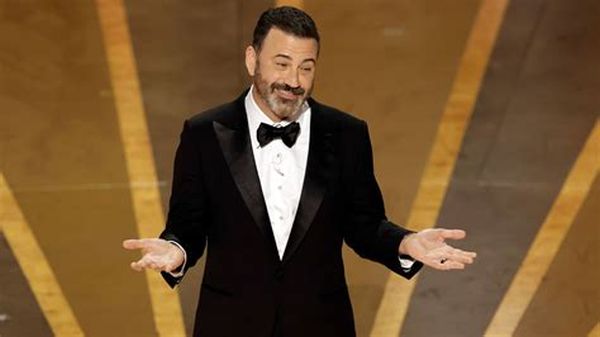
Or so it seemed to me when, on account of what was clearly a case of sheer bad manners, the late-night talk-show of Jimmy Kimmel was first cancelled and then reinstated by Disney-ABC. Yet neither Mr Kimmel nor his detractors nor his defenders in the media could see it as anything but a legal, even a constitutional, matter. Mr Kimmel’s dismissal was supposedly a violation of the constitutional protection of free speech. Katrin Bennhold of The New York Times compared it to Josef Goebbels’s sacking of some comedians who made fun of Nazis in pre-war Germany. Naturally, the comedian’s triumphant return a few days later was celebrated as a great victory for free speech, constitutional government and the American way.
Never mind that many of these new-minted champions of free speech had spent the previous four years defending censorship by the government of opinions they disagreed with. When Jake Tapper of CNN called Mr Kimmel’s cancellation by ABC “pretty much the most direct infringement by the government on free speech that I’ve seen in my lifetime,” Matt Taibbi wrote:
It’s unconscionable for Tapper to say this in the same week that Google admitted submitting to “repeated and sustained” government pressure during the pandemic, pressure that happened to thousands of people instead of one and lasted years instead of days.
Even more unconscionable, in my view, was the fact that neither Mr Tapper nor any of the legion of other media folk celebrating Mr Kimmel as a free speech martyr appeared to be able to think of a single reason why someone might refrain from doing anything he was not prevented by law from doing. If anyone in public life still remembers the vital social function once played by the most elementary kind of good manners, it has not yet been brought to my attention by the media.
Manners, wrote the British jurist Lord Moulton (1844-1921) are “the domain of obedience to the unenforceable” where man is “the enforcer of the law upon himself.” Those words were published (posthumously) just over a century ago, when neither Lord Moulton nor anyone else could have foreseen a time when so many people in public life not only recognized no such domain but acted as if they had never heard of such a thing.
What got Jimmy Kimmel in trouble was the following observation about poor Mr Kirk’s murder a few days previously: “We hit some new lows over the weekend with the MAGA gang desperately trying to characterize this kid who murdered Charlie Kirk as anything other than one of them, and doing everything they can to score political points from it.”
Already when he said it, it was pretty clear that, although the murderer came from a conservative family, he was, in fact, “anything other than” conservative himself. You only had to look at the kind of people who were celebrating the murder on Blue Sky and elsewhere on-line. Not many of “the MAGA gang” represented there, I think. And the obviousness of Mr Kimmel’s untruth caused Brendan Carr, chairman of the Federal Communications Commission, to characterize the remark as a “lie” and therefore contrary to FCC rules. That, in turn, was seen by the left as evidence that the hated Trump administration had a hand, at least, in ABC’s decision to cancel the Kimmel show.
This was almost certainly untrue, since the show was losing money and the network was much more likely to have seized on this excuse to cancel him, as CBS cancelled Stephen Colbert’s show last spring, for its low ratings. President Trump also wrote on Truth Social that Mr Kimmel ought to be cancelled, but his tweet had no force in law and was even less likely to have influenced ABC’s decision.
So all the fuss over “free speech” was a red herring, which naturally put the media, left, right and center, off-track and into its most sanctimonious, Tapper-like mode of hysterical hyperbole. Even those who deplored Mr Kimmel’s remark appeared to believe that the allegedly Voltairean aphorism about defending to the death his right to say it applied to his case. But what was, or ought to have been, in question was not the man’s rights but his manners.
On his return to his network slot, Mr Kimmel claimed both that the offensive words had been a joke, because they showed that President Trump could not take one, and that they weren’t a joke, because they weren’t funny — though, to be fair, that was true of most of his jokes. Like them, however, it was presumably supposed to have been funny. That’s typically how ill-mannered people attempt to excuse themselves after saying something totally legal but both malicious and unfunny. Can’t you take a joke?
I suspect that some such thought was also in the minds of those who celebrated Charlie Kirk’s murder on social media. Can’t we take a joke? There’s something about the anonymity of the medium itself, even for those who use their real names, which allows one to detach oneself from any serious implications of what one says or writes — to forget, for instance, all about that little girl growing up without a father — on the unstated ground that it’s all in good fun, really.
How else to explain the recent finding of a YouGov poll that “most Americans say it is unacceptable to be happy about public figures’ deaths, but younger and more liberal Americans are more likely to call it acceptable”? Neither the pollsters nor the polled seem to have recognized that this is actually a question about manners, as are all questions involving “acceptable” and “unacceptable” things, and implies that these words now mean quite different things to different groups of people.
Old-timers may still understand that the words “acceptable” and “unacceptable” are meaningless, or redundant, if they apply only to one person. If they think that public rejoicing at anybody’s death is unacceptable, they mean that it’s not just unacceptable to them but to all decent people. Those “younger and more liberal Americans” who profess to think it acceptable clearly don’t know what the word means. For them, everyone is now entitled to be his own Emily Post and thus to “accept” anything that amuses him. It’s like saying that he “accepts” his food and drink or the air he breathes.
I can’t say that I’ve ever checked out “furry porn” online, but I get the impression that those who have, like Charlie Kirk’s killer, also regard it as a light-hearted divertisement, like a Jimmy Kimmel joke, which may not be funny, exactly, but which carries no moral freightage and leaves no stain on the souls of those who indulge in it. Certainly men pretending to be women, like the alleged lover for whose sake the deed was allegedly done, has been matter for comedy for centuries. Did Charlie have to die because someone thought he was laughing at him?
But back to the funny headline I mentioned at the beginning. I read it on Spiked Online: “Why Trump is not ‘literally Hitler’.” It was apparently not intended to be funny — unlike, for instance, the Babylon Bee headline about Charlie Kirk’s funeral, “Nazi Rally Inspires Millions To Forgive And Love Their Enemies” — but that made it all the funnier. Cory Franklin, the author of the article which followed, described in detail what would have happened to the Code Pink demonstrators who disrupted a dinner at a restaurant in Washington, D.C., attended by the President and several cabinet colleagues, if Mr Trump really had been “literally Hitler.”
Of course the rhetorical strategem of treating a transparent falsehood as if it were a statement of sober fact has to be done with a straight face, but there is also a certain pathos to it. The people who think, or pretend to think, that the late Nazi dictator, age 136, is currently governing the U.S. disguised as a real estate developer from Queens are presumably so lacking in self-awareness, never mind historical knowledge, that they will never be able to see the joke or share in the laughter at their own expense.
Can we at least hope that some of those in the media who know better but have hitherto been prepared to tolerate such malicious dishonesty in their ideological confreres as politically useful may be shamed by Charlie Kirk’s murder into calling time on the rhetorical warfare that cannot but have contributed to the mental illness of his killer? Alas, I fear not, for by yet another wonderful irony quite invisible to themselves, their rallying cry, that only yesterday was for censorship, is now “freedom of speech.”
Manners, of course, can be seen as a socially (as opposed to legally) imposed restraint upon our freedom, but the Earl of Shaftesbury looked at it the other way around: “All politeness is owing to liberty,” he wrote.
We polish one another, and rub off our Corners and rough sides by a sort of amicable Collision. To restrain this, is inevitably to bring a Rust upon Men’s understanding. Tis a destroying of Civility, Good Breeding, and even Charity it-self, under pretext of maintaining it.
Manners, in other words, are not an infringement upon liberty but the only way of preventing its collapse into a state of promiscuous and licentious hatred, shading into violence, such as we see all around us today. This is what Douglas Murray calls “the Gray Zone of Political Violence,” where the now-routine language of politics and public policy (Nazi, fascist, white-supremacist etc), by characterizing all disagreement as a species of blood-thirsty extremism, hints at violence without explicitly advocating it. And people like Sean the Sandwich Slinger or the Trump=Hitler crowd or Charlie Kirk’s killer — people who are objectively ridiculous but incapable of laughing at themselves — will always be among those who are ready to take the hint.
This is the “radical normie terrorism” diagnosed by Christopher Rufo: renegade middle class kids from decent homes who give themselves permission to violate their parents’ bourgeois norms (and every other kind of norm) in defense of their own imagined dignity and moral seriousness. If they are ever to be blessed with self-awareness enough to see this for themselves, it must be the work of the media, and the comedians, who are instead devoted to doing everything possible to flatter their self-delusion. I wish I could see this sad state of affairs changing anytime soon.
Discover more from James Bowman
Subscribe to get the latest posts sent to your email.