Obsession
 Don't Bother
In 26-year old Curry Barker’s hit movie Obsession, the ironically-named Bear (Michael Johnston) is a young man who works in a music store and is too shy to ask Nikki (Inde Navarrette), his pretty co-worker, to go out with him. Instead he buys a sort of magic wand or stick called a “One Wish Willow” which claims on its packaging that, if you break it while making a wish, the wish will come true. “I wish,” says Bear, breaking the stick, “that Nikki Freeman loved me more than anyone in the f*g world.
Those who are familiar with fairy tales — or movies with supernatural characters and events — can pretty much guess what happens next. So here’s Bear on the phone some time later with the One Wish Willow help line, whose number he finds on the box it came in.
Helpline: If you have any questions about how the wish works, or, if you read the back of the box. . .
Bear: I mean, is it even real?
Helpline: Yeah, it’s real.
Bear: No, I know that the. . . Is her love real?
Helpline: Just because you chose this for her doesn’t make it less real.
Bear: Okay, then I would like to cancel.
Helpline: You’d like to file a cancel request?
Bear: Yes, yeah, a cancel request.
Helpline: We don’t really do that.
Bear: What?
Helpline: We don’t really do that.
Bear: You were just making it sound like I could put in a request.
Helpline: I was just guessing your intentions, man.
Bear: What the —? How —? What would the —? What can I do, then?
Helpline: Nothing really
The words real and really in this mocking, ironical sense ring like a chiming clock throughout the movie, which is said to be far out-earning the Star Wars sequel at the box office these days. As it does here, the word sometimes pops up in a question — Is it real? — and sometimes as a statement: “It is real,” for this is the question and this the answer that the classic horror film strives to keep always in the forefront of the viewer’s mind.
But there are no more classic horror films being made today. Now the trick has been performed too often for the audience not to be on to it. We know it’s not real — what is, anymore? — which is why contemporary horror has to be done at least semi-playfully and mixed with comedy, either intentional, as in the bit of dialogue above, or unintentional. Elsewhere in Obsession, I think it’s a mixture of both.
On the one hand the film’s young, fresh-from-YouTube director seems to want to preserve something of the mystery of the supernatural forces at work both in the all-consuming simulacrum of a love-affair between Bear and Nikki and behind the scenes, on the other end of the One Wish Willow help line. On the other hand, the means that Bear hits upon to make Nikki his own without hitting on her, is too cheesy not to be a deliberate self-parody.
The box the magic comes in, for example, is made to look like one of those old-fashioned, “Amaze Your Friends” novelty items, like a whoopee cushion or a dribbling water glass. The One Wish Willow itself is supposed to operate like Brangäne’s love potion in Richard Wagner’s tragic music-drama Tristan und Isolde, but in this context looks more like the gypsy Madam Rue’s “Love Potion Number 9” in the Lieber and Stoller song that was a hit for the Searchers in 1963:
I told her that I was a flop with chicks;
I’d been this way since 1956.
She looked at my palm, and she made a magic sign;
She said, “What you need is —
Love Potion Number Nine”
Later, another character in Obsession uses a “One-wish willow” to wish himself a billion dollars, and the money promptly pours down upon him like a tropical rain. There’s no more mystery about it than there is about Madam Rue. Or a vending machine.
Of course there are other archetypal themes at work here, and the short story from 1902 by W.W. Jacobs called “The Monkey’s Paw” is said to have been in Mr Barker’s mind when he wrote the screenplay. But these boil down to your mother’s injunction to “be careful what you wish for.” In any case, it’s hard to take the deeper moral meaning any more seriously than the horrific transformation in Nikki who, so the film itself tells us, is not really Nikki anyway. The guy on the help line hints that the real Nikki is with him, not Bear, and undergoing some kind of torture, as Bear is being tortured by her Doppelgänger. Later she seems to be hovering in the air somewhere above the sleeping zombie-Nikki, asking Bear to kill her.
Some commentators, however — notably Matthew Schmitz of Compact — find a larger, social significance in the film. Mr Schmitz calls it “Heteropessimist Horror,” by which he means that young people of Mr Barker’s age and younger are inclined to see in it the very image of what frightens them half to death about marriage or, indeed, any kind of romantic entanglement. Curry Barker’s is the voice on the other end of the One Wish Willow helpline who says: “If you die, the wish will go away.”
What price now “till death do you part”? Bear then asks in his typically wheedling way: “You’re sure there’s nothing else I can do?”
“Yeah, I mean, as long as you live. Sounds to me like you have a moral obligation to be there for her.” Or at any rate to be there for the insanely, murderously jealous automaton she’s been turned into by your regrettable wish to possess her.
In other words, no romance, please, we’re Gen Z. Supposedly. I’m sure this cannot be true for a whole generation, and that those for whom it is true may still grow out of a fear that must threaten the survival of the species. But I think it is true to say that one side in the so-called “culture war” in which we in America and elsewhere have been long engaged has an interest in fostering such a fear, just as it does in encouraging women to abort their babies.
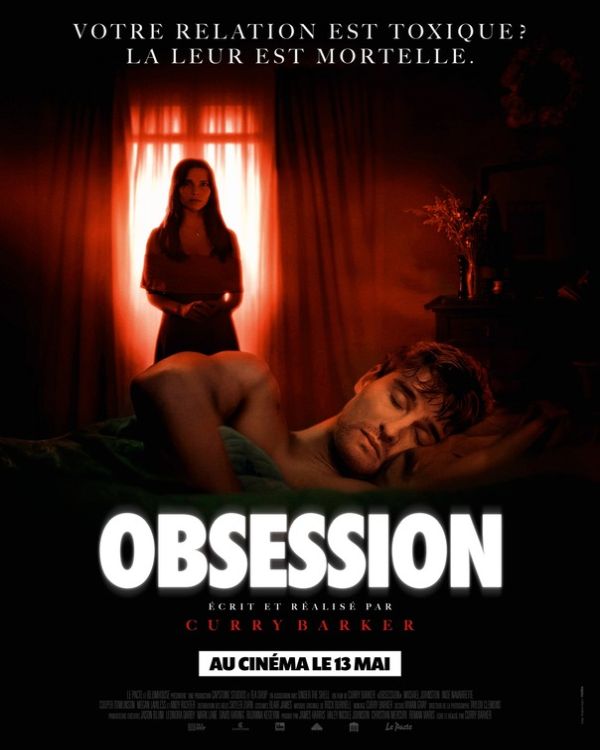
The movie-poster tag line on Obsession’s release in France reads: “Votre relation est toxique? Le leur est mortelle.” Which means: “[You think] your relationship is toxic? Theirs is deadly.” That puts it in a nutshell. People who have been taught by the therapeutic culture they’ve grown up in to see relationships that no longer please them as “toxic” are likely to be all too easily persuadable that their very survival is at stake if they make the kind of commitment to one another that their parents were expected to make as a matter of course. Here’s just one more item in the bill of goods that the progressive left has sold them in recent years.
Discover more from James Bowman
Subscribe to get the latest posts sent to your email.