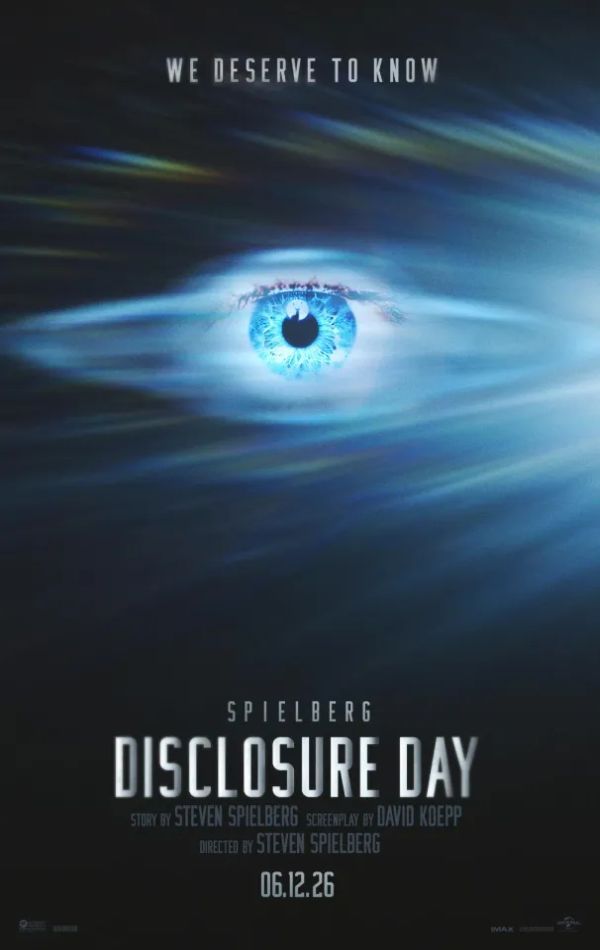
Disclosure Day
 Don't Bother
Crafty old Steven Spielberg. In his latest film, Disclosure Day, the great director and inventor of the summer blockbuster has taken his well-known obsession with space aliens and suchlike fauna and used it to misdirect his audience to look past the movie’s real purpose while subliminally absorbing it. He means to get inside the audience’s heads through the power of empathy exactly as the movie’s own two “experiencer” heroes are alleged to do, at will, with anyone they meet who may be useful to them.
What these experiencers, Danny (Josh O’Connor) and Margaret (Emily Blunt), are said to experience is the ultimate secret of the universe, first confided to them by the kindly aliens who kidnapped them in childhood and performed some kind of operation on their left eyes. The secret is that empathy is not only our greatest evolutionary advantage but, when accompanied by a TV remote-sized black box full of (presumably) totally cool hi-tech stuff, also a powerful tool to dominate anyone and anything, or even make you invisible to your enemies.
Danny and Margaret start out apart — he a techie in Northern Virginia, she a TV weather reporter in Kansas City — and unknown to each other. But the picture eventually brings them together in KC as the objects of several action-packed chase sequences, filmed with typical Spielbergian verve, as they try to deliver to the truth-lovers of the media all the government’s hoarded up secrets from 80 years of UFOs and alien visitations against the wishes of the government.
The government here is represented by a fictional outfit called Wardex, charged by the official government with the study of the alien presences and the protection of their documentary evidence from the disclosure to the public that Danny and Margaret are trying to effect. Wardex is headed by an Inspector Javert-like figure called Noah Scanlon (Colin Firth) who apparently has virtually unlimited police powers at his disposal in order to stop them.
The police, meanwhile, are headed by a ruthless killer named Casper Boyd (Henry Lloyd- Hughes) who is the total reverse of empathetic, while Danny and Margaret are remotely guided towards safety in the bosom of the all-powerful but totally benevolent media by a Wardex renegade named Hugo Wakefield (Colman Domingo).
As I began by saying, however, all the space-melodrama — including, at the film’s climax, an actual alien, in the clever disguise of every other space-alien Hollywood has represented to us for the last half century or so, come to address the People of Earth just like Michael Rennie (the last time aliens looked like tall, dark and handsome white men in the movies) in The Day the Earth Stood Still (1951). This time, the big-headed, big-eyed, spindly-bodied alien has to speak through his Earthling interpreter Margaret who, after much whispering between her and Danny and the alien, steps to the podium in the film’s last seconds and says: “Listen —” [blackout]
What is it that are we supposed to “listen” to? What else but the film itself which, for those who can understand its unearthly language, turns out to be an allegory of Donald Trump’s America, as Hollywood sees it.
Cunningly, however, Mr Spielberg never mentions the President’s name, nor does he include a character overtly meant to stand in for him. Instead, he creates a massive police action centered in a midwestern city intended to keep America pure from the taint of, even the knowledge of, aliens and opposed by native empaths gifted by the aliens with something of their own empathic superpower which allows them to triumph over a swarm of brutal federal agents (nominally working for Wardex) in baseball caps and body armor and dark blue unforms without insignia who are willing to kill anyone who gets in their way.
Remind you of anything?
Though the movie was still in post-production at the time of last winter’s siege of Minneapolis, it presents us with an uncanny resemblance to it, in which Margaret stands in for an idealized Renee Good, and Danny for Alex Pretti, the highly empathetic (to aliens) Minneapolitans dedicated to defending any and all alien intruders from ICE. In this scenario, Casper Boyd is Jonathan Ross, Noah Scanlon is Tom Homan — who experiences an unexplained change of heart at the film’s climax — while gentle Hugo Wakefield, shepherding his people away from the big bad federal policemen, is obviously Tim Walz.
I don’t mean to say that the movie is not — as everybody, led by Mr Spielberg himself, seems to believe — about religion, albeit a peculiarly Spielbergian religion that replaces the deity with shadowy and inhuman technical intelligences. At one point Jane (Eve Hewson), a young novitiate nun, tries to talk Danny out of his mission of disclosure: “People have been raised to believe in a Supreme Being, and now you want to show them actual supreme beings? The world can’t handle both.”
The absurd idea of “actual supreme beings,” plural, really does seem to be how Mr Spielberg sees the omniscient and omnipotent power of the empath. The “Supreme Being” here turns out to be just another movie super-hero. But that’s really the point. Steven Spielberg has made religion and politics into the same simplistic ideology, which is not Leninism so much as Lennonism. All you need is love, man. Or empathy — with or without the enabling alien remote-control device by which Daniel and Margaret effortlessly know everything and can do anything.
Both politically and religiously, it’s all so easy that it’s no wonder the Lennonist Democrats who run Hollywood and, now, so many others of our once proudly American institutions, get so cross with us non-believers. How can we not see these simple truths that are so clear to them?
The real division in the movie, as in our politics today, is between fantasists and realists, which is why it is not all that surprising that Disclosure Day managed to anticipate the media narrative about Minneapolis in so many ways. The fantasy of benevolent aliens using their powers of empathy to teach us cold, Western rationalists their own caring (but powerful!) ways is only one example of the left-wing and utopian thinking that is increasingly the only recognizable alternative to Trumpism so far as the media are concerned.
Rod Dreher, author of Living in Wonder, naturally focuses on the movie’s religious teaching which, writing on his Substack, he identifies as a latter-day example of the heresy of Gnosticism, and he hints of its Satanic affiliation.
You, reader, might be able to watch Disclosure Day and spot the obvious problems and deceptions in its narrative. But it is extremely unlikely that most Christians you know can. They will be taken in by the pious older nun who appears serene in the face of disclosure, without questions about what the aliens claim, and what challenges they pose to Biblical truths. After all, if religion is about nothing more than increasing our love and empathy, then why not?
Does this not presuppose that “most Christians” will automatically assume an obvious cinematic fantasy, derivative of a thousand others just like it and with a utopian message of extreme Lennonist banality presents something real to them? Perhaps he’s right, but I would be even more depressed than I already am if I allowed myself to think so. Christianity, properly so called, is no fantasy but has got to be the ultimate in realism.
Discover more from James Bowman
Subscribe to get the latest posts sent to your email.