Project Hail-Mary
 Don't Bother
At the movies as in fiction I am, like most people, a willing believer in happy endings. But that willingness to believe must begin to fade, for those with minimally discriminating taste, along with the plausibility of the ending in question. In other words, the feel-good dénouement has got to look pretty real or it won’t feel real good at all. If the happy ending hasn’t been earned, as we might say, it will look like sentimental claptrap by an author who couldn’t be bothered to make his invented world look like anything approximating the world that is, in the words of Ludwig Wittgenstein, “everything that is the case.”
This means that science fiction always starts out with what seems to me to be an almost insuperable disadvantage, since the stuff it works in looks unreal even before the story begins. In fact, its unreality is the very basis of its appeal to the mostly undiscriminating audiences of today. Yet, like any other novelist or film-maker, the creators of science fiction and fantasy must feel, however faintly, reality’s gravitational pull, drawing them down to earth — at least they must if they and their audience are not to be content with producing an animated comic book.
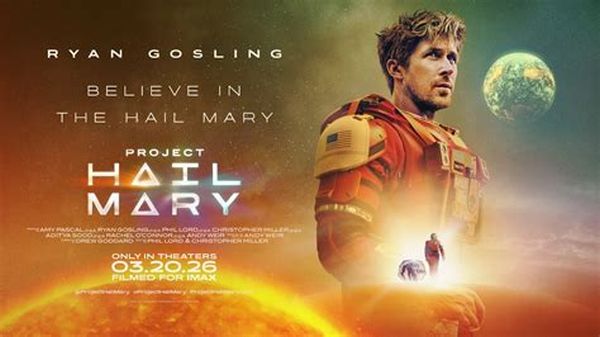
The authors of the smash-hit Project Hail Mary are not the first to answer reality’s call by dreaming up an interplanetary bromance between a goofy but lovable earthling and an earnest but even more lovable alien being, brought together by the need to save the world from — what was it again? Oh, yeah, an “astrophage” or star-eating virus that is gradually consuming both our own and the alien’s planet’s suns, converting each star’s energy, it is said, into its own means of propulsion.
That’s pretty implausible right there, given that the virus is supposed to be a living thing that can be killed, as our heroes discover in short order, but that is not killed by the 10,000 degree temperature of the stuff it must consume just to move around and get its next meal. But whatever. Maybe they can make up for it with some good jokes, like saying that the viruses “toot to scoot.”
The alien in this case is a vaguely anthropoid (or possibly arachnoid, but with thumbs) collection of articulated (and articulate) rocks called, (what else?) “Rocky” by his earthling buddy, Ryland Grace (Ryan Gosling), a lowly middle school science teacher who is press-ganged into acting as science adviser to the mission to capture and kill the wild astrophage. When his two fellow astronauts die on the long voyage into the void, he is also, despite having no military training, the pilot and commander of the space ship.
The many encomiums of praise I have read about this saga of the interstellar voyage of the Hail Mary and its one-man crew that do not see it as an allegory of the Christian salvation narrative — note, for example, the celestial hero’s name, Grace — have been mostly impressed with its presentation of him as a masculine role model of a traditional but now mostly out-of-fashion kind.
He is supposedly not, that is, one of those hitherto fashionable superheroes who never bothered about believability because they were only ever meant for the tastes of an immature audience. By the way, I think that the long run of the superhero in the popular culture — and, of course, his super-villain alter ego — must bear at least some of the responsibility for the media’s cartoon caricatures of presidents and other public figures in recent years as either one or the other: Obama as the superhero, for instance, paired with Trump (or Jeffrey Epstein) as supervillain du jour.
So we should all welcome the new lease of life for the unsuper-hero, a role for which Grace is certainly eligible. “I put the ‘not’ in astronaut!” he says — a trifle too cleverly? “I’ve never done a space walk, I can’t even moonwalk! I haven’t done any training, I haven’t done the whole. . . the pool thing!. . . I’m not heroic in any way. I get sick on an elevator!” Of course, that’s just what a real hero would say! Here’s a little passage of dialogue from the movie:
Rocky: You are very brave.
Ryland Grace: I don’t know about that.
Rocky: You are bravest human I have ever met.
Ryland Grace: Hey!
Rocky: Is joke!
Ryland Grace: I know.
Rocky: I only meet one human. And it’s you!
Ryland Grace: I get it.
Rocky: It’s good joke.
Ryland Grace: Good joke.
Making light of his own heroism is also something a real hero would do. At another point Grace tells Rocky that he has made his peace with the fact that he is on what amounts to a suicide mission. But when hope dawns that he may, after all, return safely to Earth, Rocky asks him what about this claim of having “made his peace” with a lonely death in space. “I didn’t mean any of that,” says Grace, puncturing the heroic posture again. “That’s just something you say.” Surely, however, he doesn’t really believe this — that it’s “just something you say.” Like a real hero, he just doesn’t want to appear to boast of his own stoicism.
But I fear that making the hero a bit more believable qua hero than a superhero is not enough to make the movie itself remotely believable. Mostly this is because, for all the astronautical exotica, the mise-en-scène is all too familiar. We’ve seen this movie before — mostly as a sitcom like I Dream of Jeanie where the alien presence takes the form of a cute but scatter-brained girl to whom everything must be mansplained by her earthling partner and straight man. It’s just George Burns and Gracie Allen in outer space — except that, there, the “Grace” is on the other foot.
For the bromance on the Hail Mary is made (deliberately, I think) to look more like a marriage. Rocky is referred to by masculine pronouns and is said to have (or to have had) a “mate” on his own planet with whom he was together for 186.3 years — apparently “a long time” even in his planet’s years. But no more is heard of Rocky’s mate, and Grace himself is divorced. His wife left him for a man named Mark, and the rock-pile can empathize. “Rocky hate Mark,” says Rocky to Grace.
Like any marriage, too, their partnership has its frustrations, especially where Rocky’s planet appears to be the more technologically advanced. Grace confides to his voice-recording diary: “He tells me what to do; he tells me why to do it; he tells me how to do it; he tells me when to do it. And then, when I do it, he’s like, ‘what are you doing?’” Grace thinks Rocky can’t hear his complaints about him to his silent electronic marriage-counselor, but, like a wife who has her husband under constant surveillance (or vice versa), it can.
All this is to suggest that the ordinary-guy hero becomes a little too ordinary. So ordinary, in fact, that he no longer looks very much like a believable hero. Of course [spoiler alert] the earth and Rocky’s planet both get saved in the end, and it is even hinted that the dynamic duo of Grace and Rocky can still be together, maybe as crime-fighters, on one planet or the other in the happy hereafter. So it happens that such total success for the supposedly last-ditch mission of the Hail Mary turns out to be the stuff of superhero comix after all.
Discover more from James Bowman
Subscribe to get the latest posts sent to your email.