Of lost wits and nitwits
“What do you do when your party loses its mind?” asked Gerard Baker of The Wall Street Journal
earlier this summer, when people calling themselves “Democratic Socialists” were winning Democratic primaries in left-leaning constituencies all across the land. To most of us, I think, the answer to his rhetorical question would be pretty obvious: you vote for the other party. But that seems to be hardly an option for Mr Baker and a lot of other would-be Democratic voters. Their inveterate hatred for President Trump makes party-switching all but unthinkable for them. It is also, I think, the reason for their party’s loss of its mind in the first place.
For this year’s successes of the DSA’s “Nitwit Revolution” (as Matt Taibbi has called it) must be the result of a choice not to vote at all by Democrats who, like Mr Baker, think their party has lost its mind. “Hollywood, Madison Avenue, and the news business are all ready to roll out the red carpet for the proven-worst, most anti-American set of ideas in existence,” wrote Mr Taibbi. “Voting for the end of Western civilization! If it weren’t so horrible, it would be funny.”
Those of us who prefer to be governed by sane people will naturally hope that the non-voters in Democratic primaries, if they can’t bring themselves to vote for a Republican, are still staying home in November, but many of the Democratic Socialists appear to enjoy absolute majorities in districts where Republicans hardly exist. In any case, it would now be foolish to count on a voting majority anywhere in the country which, when faced with the choice of Republican or crazy, could be relied upon not to vote crazy.
Why is this? Why do otherwise sane people decline to inflict any penalty for craziness on their own party? I think it’s because political parties are not just political parties anymore but political identities. They are, to use a favorite phrase of the young and those with insecure identities, who you are — in your own mind, anyway. Which really means who you want to be or, more precisely, who you want to be seen to be. In other words: one of the good people. That’s your brand, after all, and you don’t leave off being good just because other good people are going crazy. That doesn’t make you want to join the bad party, the party that you have spent your entire life thinking of as such.
If the good party changes out of all recognition, even if it goes crazy, it doesn’t, therefore, stop being good. It becomes even more who you want to be because it appears to be in danger of becoming what you don’t want to be. And if that finally happens — as many Democrats seem to have felt after Joe Biden and Kamala Harris trashed their brand — you do switch to another party. But the party you switch to is the Democratic Socialists. In other words, the crazy (but cool!) party of the good.
Of course if you’re a Democrat you’re pretty much bound to blame your party’s loss of its mind on President Trump — as if, by winning the endorsement of the American people he had left the out-party no alternative but to run distracted with hate, not only for him but for anyone who has ever voted for or had a good word to say for him. Lots of people on the right are criticizing President Trump, or the Democratic caricature of him, for “hand[ing] the left permission to come unglued,” as one article put it.
But the most prominent example of Democratic craziness is the Jew-hatred which now seems rampant in the party, and not only on the far left. Just ask Senator John Fetterman, who is virtually the only nationally prominent Democrat who still speaks up for Israel against Hamas terrorism and is routinely reviled for it in the party. It’s hard to see how President Trump can be blamed for that sort of craziness. On the contrary, his solicitousness towards the Jewish state is what many if not most of the radical opposition hate most about him.
The mistake that such observers make is not just to assume that the Democrats’ hatred of Mr Trump is rational, or even that it begins as rational and eventually takes an irrational form. It is, rather, to suppose that the two sides of our deep political divide are engaged in the same kind of norm-busting — norm-busting for the hell of it, as we may say, or merely to answer the other guy’s norm-busting. Such criticism arises out of the old “a plague o’ both your houses” temptation that flatters the self-conceit of those, particularly those in the media, who will always take pride in being above the battle themselves and so superior to what Teddy Roosevelt called “the Man in the Arena.”
Alternatively, you may imagine that you yourself are the man in the arena. That’s what Senator Andy Kim of New Jersey called Anthony Fauci during his non-testimony to the Senate’s Homeland Security committee about his lying to the country when, by his own estimation anyway, he was the official voice of Science during the Covid-19 pandemic: Dr Fauci as the hero he always imagined himself to be. I guess you could look at it that way — the same way you could agree with Michael Greenberg of the New York Review of Books that, “as Democratic Socialists rack up primary victories, the moderate wing of the Democratic Party looks increasingly out of touch.” Or, “Heavy Fog in Channel, Continent Cut Off” as a British newspaper headline once put it.
“Is all in how you look at it,” as Stan Freberg’s imaginary Caribbean indigene said to Columbus in claiming to have discovered him instead of the other way around.
A more serious look at left-wing mind-loss is offered by Jake Altman of City Journal who writes: “I Watched the DSA Go Crazy. The Democrats May Be Next.”
For decades, the DSA was mostly composed of a cohort of aging Boomers left over from its founding in 1982. It prioritized open debate and political tolerance. Following in the tradition of founder Michael Harrington, members viewed the DSA not as a revolutionary vanguard but as a reformist bridge to mainstream labor-liberalism, and they prioritized parliamentary process and pluralism. But in the mid-2010s, the character of the organization began to change. . . As the organization grew, it began to profess more extreme ideas—and demand that its members do the same. First there were the purity tests of Black Lives Matter and BDS, then apologia for Putin’s invasion of Ukraine and support for Hamas and its atrocities. The new DSA—with the help of hype-man Hasan Piker — advanced these agendas with what American labor leader Walter Reuther called “the Communists’ highly developed technique of name-calling and character assassination.” The Harringtonites fought back, but their efforts came far too late, and many prominent members of the older generation eventually left.
Mr Altman sees the same left “entryism” (as it used to be called) now taking place in the Democratic party — enabled, perhaps, by the reluctance of more tradition-minded party members to object for fear of being shamed as objectively pro-Trump. If the choice is between Making America Great Again and crazy, they’re going to choose crazy.
Of course it helped if, like Andrew Cuomo, you believed that America “was never that great” to begin with. In fact, for many if not most on the left, the craziness has its roots in a contempt for American history, which they only know (if they know it at all) through the works of such hostile witnesses as Howard Zinn, Nikole Hannah- Jones of the 1619 Project or Anthea Hartig of the Smithsonian’s National Museum of American History, who also testified to a Congressional committee in July about her “re-framing” of the Museum’s account of our history according to her own belief that American “democracy was founded on the backs of African and . . . Indian slavery and genocide.”
She was called to testify before the House Subcommittee on Delivering on Government Efficiency (they must have felt that calling it the House Subcommittee on Government Efficiency wouldn’t pass the laugh test) in response to a report, issued by the White House Domestic Policy Council on the Fourth of July called Saving America’s Story, which averred that the Smithsonian “cannot be trusted to tell America’s story honestly and in a way that is inspiring, unifying, and worthy of our great republic.” Needless to say, she denied all charges. And it was not the DSA who wrote the Democratic rebuttal to the White House report, claiming that it was not the Smithsonian but the president who was guilty of “re-writing” American history. It was issued in the name of veteran New York Democratic politician Joseph D. Morelle, the committee’s ranking member.
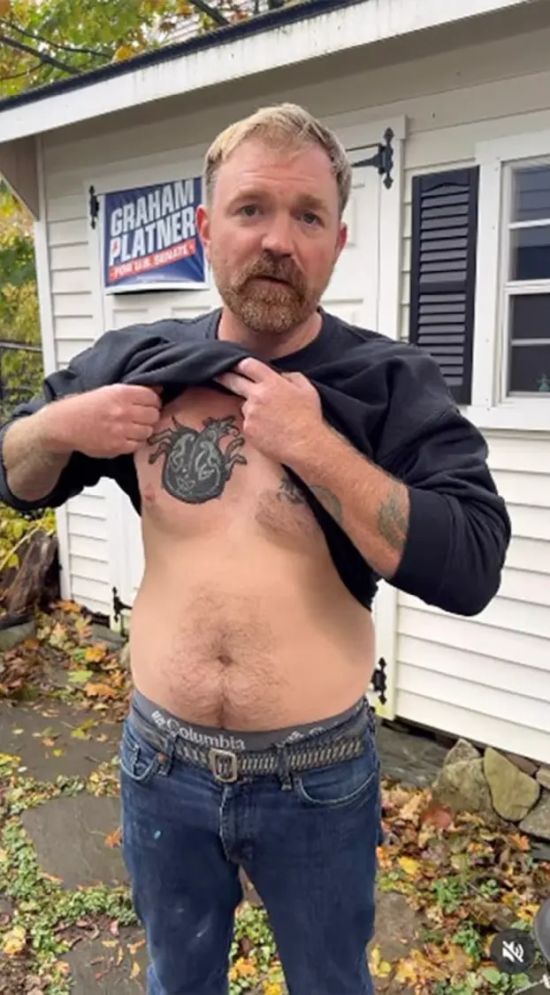
Against the towering figures of the Founders and other historical figures who were once believed to have built the country, the left sets the personal authenticity of anyone who can claim, however implausibly, to be their victim. Here, for example, is Democratic campaign consultant and “Mad Scientist” Dan Moraff explaining in an interview with Aaron Zitner of The Wall Street Journal about how he came to choose the year’s most disastrous left-wing candidate, Graham Platner — the man who won the Democratic primary to run against Republican Senator Susan Collins of Maine in a landslide, only to drop out of the race in July after a second accusation sexual misconduct against him (this time of rape):
Part of our thesis here is that people do not want their candidates grown in vats. They want people who are real human beings, and they want people who do not look and sound like the vat grown people who’ve been leading this country off a cliff for the last century. And that was Graham.
Some country! Some cliff! Let’s see, the last century would take us back to Calvin Coolidge, after whom came Herbert Hoover, Franklin Roosevelt, Harry Truman, Dwight Eisenhower, John F. Kennedy, Lyndon Johnson, Richard Nixon, Gerald Ford, Jimmy Carter, Ronald Reagan, George H.W. Bush, Bill Clinton, George W. Bush, and Barack Obama before we get to Donald Trump who, as all Democrats will presumably agree, has indeed been leading the country off that fabled cliff. But is he then, no different from all the others? Were they all “grown in vats”?
Here sounds the typical left-wing attitude to history: everything up until the day before yesterday is trash: that’s what they must suppose in order to persuade the more credulous members of their party that this new and exciting oyster-farmer is going to start with a blank slate and endless possibilities to transform the country into a paradise. What does it say about the Democratic electorate that they are so susceptible to such a pitch?
Or are they? If it is, as I believe it to be, sound advice never to believe what the media tell you without independent confirmation, ought we not to treat with some skepticism media reports of the current Democratic craziness? Not because there is no craziness in the party just now but because it is limited to a much smaller fringe than the crazies themselves, like the sensationalizing media, would like you to believe. Also because a lot of the craziness is not only rhetorical but meant to be rhetorical, and limited to the rhetorical.
And for this, I think we have to admit that President Trump must bear some of the blame. His own rhetorical excesses are understood by his followers as jokes, like the famous one from his first term, still repeated by some of his detractors as seriously intended, about injecting bleach as a specific against Covid infection. And there can be no doubt that a lot of the opposition’s failure to “get” the joke is entirely disingenuous — an excuse for being more seriously outrageous themselves.
Yet the rhetorical warfare between the parties, detached from any recognizable reality, long ante-dates the first Trump administration. Even the over-educated, under-employed 20-somethings with masses of college debt to pay off who are the target demographic of the Democratic Socialists are old enough to remember “Bushitler” and other invocations of the late Nazi dictator as applied to the kind of gentlemanly Republicans who seem to have died out after the Mitt Romney-Paul Ryan debacle of 2012. Donald Trump simply gave as good (or as bad) as he got from them, and it made them crazy.
It also confirmed the Democrats in their ideological certainty about their own version of reality. I say “ideological” certainty because this is a kind of certainty that is almost tantamount to uncertainty. At some level, in other words, the Democrats must know that their quasi-Marxist “progressive” world-picture cannot be superimposed upon the real world as they pretend to believe it can. They can’t be that crazy. But they have to hide this knowledge from themselves, just as they have to forget that there is hardly anything proposed by Mr Trump that wouldn’t have been advocated by mainstream Democrats only a decade or so ago, by being ever more shrill in their advocacy of their false reality.
Losing your mind is perhaps a natural consequence of losing your memory, both the national memory once shared by all of us and the memory of the Democratic party’s once sane, if occasionally misguided philosophy of governance, formerly not so different from that of the Republican party. Like their forgetting of the American story still being told universally when they were children, their forgetting of their own story, of their own sanity, is the first imperative for the establishment of the novus ordo seclorum that the Nitwit Revolution proposes to inflict upon all of us. And to that end you can, of course, say anything. You don’t have to believe it.
Discover more from James Bowman
Subscribe to get the latest posts sent to your email.