You Can See Everything
 Worth Seeing
In Disclosure Day, Steven Spielberg’s most recent exercise in cinematic moralism, empathy is described as a “superpower” — since it is the power of a super–race of anthropoid aliens who think that humanity ought to emulate them by using it. What is meant by “empathy,” however, is a kind of mind-reading that can be used by Emily Blunt’s character, the one human being who, thanks to the aliens, is really good at it, to manipulate others into doing what she wants them to do. You can see how, if it were real, this would be a superpower.
As we use the word empathy today, however, we most often mean by it something like accepting other people at their own emotional self-evaluation. This is what I feel; now I need you to validate that feeling by telling me that you can feel it too, right along with me. That sounds more like a super-weakness than a super-power to me, but admittedly we are now living in the kind of upside down world where weakness often is translatable into strength, if you know how to do it. And more and more people these days do know how to do it.
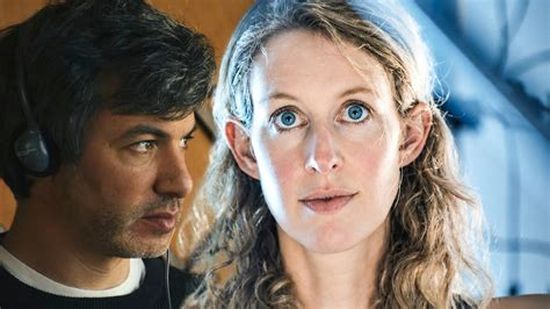
I thought of all this while watching the smash hit movie You Can See Everything, co-directed by Nathan Fielder, who also appears on camera, and, behind it, Lance Oppenheim. It stars famous fraudster Elizabeth Holmes, she of the bogus blood-testing machine company Theranos, plus her fiancé, Billy Evans, and a supporting cast of their two children, Elizabeth’s parents and, not coincidentally, Amanda Seyfried, who played Elizabeth in a Hulu fictionalization of her story called The Dropout. She also plays her here in a couple of Nathan’s re-enactments of his encounters with Elizabeth.
Here it is not empathy that is the superpower but the invitation Ms Holmes extends to the vanity of the would-be empath, Mr Fielder, to demonstrate his own empathetic powers by entering into and sort-of-almost accepting as his own the distorted sense of reality of a pathological liar. Moreover, she thereby seems to have created a doubt in the minds of movie-goers throughout the world that she just might be the real victim in the Theranos affair that she supposes herself to be.
Mr Fielder, by design, caught up with the former girl Wunderkind and reputed world’s youngest self-made female billionaire just before she was to begin a 10-year prison sentence for fraud, so there was maximum opportunity for him, and her, to milk the imminent separation of a young mother from her two adorable children for all it was worth. And it was evidently worth a lot. She invited Nathan and his film crew to come into the beach house she shared with Billy and the kids where they can, supposedly, “see everything.” Could that possibly be the act of a dishonest, or even of a disingenuous person?
Of course it could. Especially if the invitation comes from someone who so obviously shares the view, once enunciated by George Costanza of “Seinfeld,” that “it’s not a lie if you believe it.”
Nathan’s gentle probings around the edges of what Elizabeth calls “my truth” — that, for instance, “I know I didn’t commit any crimes” and even that she has never in her life, to her knowledge, told a lie — go just far enough to persuade him that this alleged “truth” is, if not real, at least really hers. That is the most that empathy can do for his forensic investigation. What it can do for his romantic feeling of becoming the rescuer of a fair damsel in distress is another matter.
What surprised me most about the movie was the reaction to it among critics and other observers who kept saying things like, “We’ll never know the real truth” about Elizabeth Holmes and Theranos — or even, in some cases, that we can never know the real truth about anything. As if the truth as established in a duly constituted court of law in 2022 could not possibly be, in some obscure sense, the real one.
Here, for instance, is Kat Rosenfield of The Free Press, commenting on Ms Holmes’s now famous inability in the film to “get” the joke of the classic Abbott and Costello routine, “Who’s on first?”
What’s impossible to know is whether this is because she’s pathologically guileless, or because she’s the world’s most ruthless, consummate manipulator, and it is this question with which Nathan Fielder becomes obsessed.
I don’t think she’s right on either count. “Ruthless” seems to me to be the exact wrong word to describe this pathologically guileless manipulator’s manipulations, since she only manipulates those who want to be manipulated — in Mr Fielder’s case who desperately want to be manipulated. Of him it would be truer to say that he is “obsessed” with Ms Holmes herself and not her sincerity or lack of it. Anyone can see she’s a consummate manipulator from the film, as if we didn’t know that already from her stunning successes at fund-raising on behalf of a worthless product.
Nathan Fielder’s wish to believe her arose, in the beginning perhaps, out of curiosity to see how, like the White Queen in Alice in Wonderland, she can make herself (and others) believe six impossible things before breakfast, but by the end of the film it seems obvious to me that he is, probably like many of her defrauded investors, more than a little bit in love with her and longs to believe in her sincerity. Even Billy, an equally obvious con-artist, finds a little space for himself beneath the penumbra of Nathan’s adoration.
Ms Rosenfield seems to think that the latter’s apparent physical attraction to his subject is a deliberate ploy on his part:
Here it may be tempting to interpret You Can See Everything as an entry into a particularly fraught artistic oeuvre, where a storyteller’s entanglement with his subject first complicates the narrative and then becomes the heart of it. . .But as compelling as this type of storytelling is, any attempt to categorize this film as part of that tradition is complicated by Fielder’s track record of not just inserting himself into his work but playing a character in it — which is to say, You Can See Everything is definitely stranger than fiction, but not necessarily the truth, and this is fine. Actually, given the subject matter, it might even be perfect.
She also notes Elizabeth Holmes’s suggestion “that one of her more incendiary quotes from a 2023 New York Times profile—‘They’re not playing me. They’re playing a character I created,’ was fabricated.” In this she may even be telling the truth, but only because the quote, if unchallenged, would contradict her insistence, both in the Fielder-Oppenheim film and in real life (as real as life gets for her, anyway), on her utter passivity and, thus, implicit victimhood both during Theranos’s heyday and ever since it.
For empathy, insofar as it really exists and isn’t just an ostentatious form of sympathy, is neither a super-power nor a super-weakness but simply the performative emotional currency of our victim culture, built around the idea that the world is divided into victims and victimizers and that the certifiable victims — certified by their membership in one of the approved classes or identity groups of the “oppressed” — must always and everywhere be exalted and their oppressors (basically, white, heterosexual men) must be cast down.
Elizabeth Holmes is obviously well aware of this, as she is of her own power of appeal to the empathy of others — which depends absolutely on her keeping up the pose of victimhood to justify the empathy she knows so well how to elicit, especially from white, heterosexual men taught virtually from birth to feel vaguely guilty about their sex’s treatment of women throughout human history. In this very limited sense, empathy really does seem to be a super-power.
Discover more from James Bowman
Subscribe to get the latest posts sent to your email.